Pre-visit callback
Automatically send reminders to help patients remember their appointment and reduce no-shows.
With Virtual Reception you can call patients back to confirm appointments, activate feedback follow-ups, or run targeted prevention and re-engagement campaigns.
Industry data and estimates, not guaranteed results.


You will be answered by the virtual assistant of Sant'Andrea Medical Center (a purely demonstrative fictional center). Any data exchanged during the conversation will be processed in compliance with privacy (full notice available at this link).
3 scenarios where calling patients back can increase loyalty
Automatically send reminders to help patients remember their appointment and reduce no-shows.
Improve the patient journey in your facility by tracking periodic check-ups or post-operative treatments.
Promote prevention by automatically informing patients about a screening campaign.
An outbound workflow designed to integrate with the front desk, not complicate it.
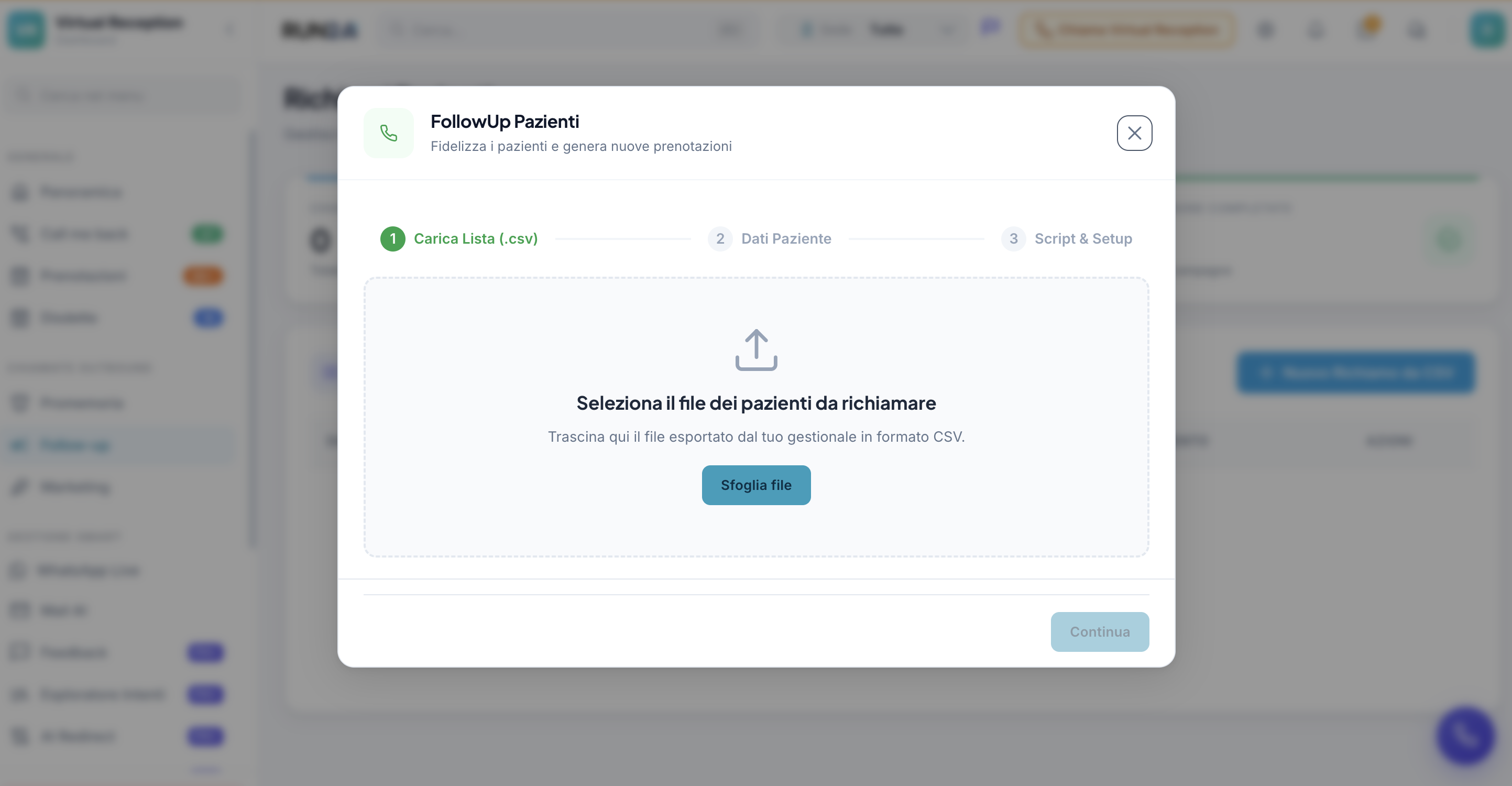
Define lists and triggers by visit type, urgency, periodicity, or dedicated campaigns.
Select the start date, duration, number of actions to run, and the campaign script.
Outcomes and rescheduling are managed from the control panel and, when needed, integrated directly into your management system.
Activate outbound without operational risk
Our technology solution complies with the GDPR - General Data Protection Regulation and the European Artificial Intelligence Act, developed according to the highest security and privacy standards. The Virtual Reception infrastructure ensures complete data protection, maximum reliability, and compliance with all current regulations.
Read the full privacy noticeEssential answers to evaluate an AI outbound strategy in healthcare.
With the outbound module, Virtual Reception calls the patient a few days before the appointment and asks them to confirm it, for example: "You have a full abdominal ultrasound the day after tomorrow, can you confirm?".
The outcome appears in the panel straight away. If the patient cancels, the freed slot shows up in time to be given to another patient instead of staying empty.
Confirmation calls reduce no-shows because they turn a surprise absence into a cancellation or a reschedule communicated a few days in advance.
Unlike a one-way reminder, the call asks the patient for an explicit answer: whoever cannot come says so earlier, and the slot becomes available again. You can also focus the calls only on patients who have not confirmed the SMS reminder by importing that list. Your front desk no longer spends the morning on confirmation calls, and freed slots can be reassigned while there is still time.
Yes: during the confirmation call the patient can confirm, ask to move the appointment or cancel it, and Virtual Reception records the outcome in the panel right away.
With an integrated management system the assistant can offer new dates from real availability; otherwise the reschedule request reaches reception as a callback request with a summary of the conversation. A cancellation frees the slot, which reception can reassign.
The patient talks to an assistant that holds a real conversation: Virtual Reception introduces itself as the facility's virtual assistant, listens to the reply and responds accordingly, with no keypad menu.
If during the confirmation the patient asks, for example, whether they need to fast or where to park, the assistant answers with the same information it uses for inbound calls: the facility's documentation and preparation instructions.
If the patient doesn't answer, Virtual Reception tries again: after 2–3 unanswered attempts a WhatsApp message can be sent.
The message uses an approved template, as WhatsApp requires when the facility writes first, and the patient can reply there, where the WhatsApp assistant carries on the conversation. The panel shows the outcome of every call.
Virtual Reception takes the appointments to confirm directly from the integrated management system or from a file you import, such as a CSV.
The file is useful to select only some patients, for example those who have not confirmed the SMS reminder, or for facilities whose management system is not integrated. Patient lists for periodic recalls are uploaded the same way.
Yes, Virtual Reception can handle periodic recalls, such as a dental cleaning or a mole check every 12 months, but you need solid consent from patients.
For actual campaigns, such as screening or prevention drives, talk to your facility's DPO first and check Italy's public opt-out register (Registro pubblico delle opposizioni). The module records the outcome of every contact, so you know who was called and with what result. A typical example is the hygiene recall in dental clinics.
Outbound calls are an optional Virtual Reception module, quoted in your proposal.
The only public list price is for the voice bot that handles inbound calls, from €224 a month excluding VAT; outbound is added only if you need it, because the service is modular. Cost structure, activation times and trial options are explained in the FAQ.
Reduce "no-shows", capture patient feedback, and improve return rates with targeted outbound campaigns.